Xanthan Gum vs Guar Gum for Food Applications
What Is the Density of Bitumen?
Bitumen density describes the mass of bitumen contained in a specific volume. Engineers usually express this physical property in kilograms per cubic meter (kg/m³), grams per cubic centimeter (g/cm³), or kilograms per liter (kg/L).
For example, bitumen with a density of 1,030 kg/m³ weighs approximately 1,030 kilograms per cubic meter when measured at the stated reference temperature.
This property matters because bitumen suppliers usually sell their products by weight, while storage tanks, pipelines, and heating systems operate according to volume.
Consequently, accurate density measurements help buyers compare deliveries, calculate storage requirements, and maintain consistent asphalt mix proportions.
Bitumen density also provides useful information about the material’s physical characteristics. However, density alone cannot determine binder quality, penetration grade, viscosity, or performance.
Density of Bitumen in kg/m³
Most conventional paving bitumen grades have densities close to that of water at room temperature. Nevertheless, different crude oil sources, refining processes, and chemical compositions can produce different results.
The following table presents broad illustrative density ranges for several bituminous materials.
Bitumen Type | Indicative Density at 25°C |
|---|---|
Penetration Grade 60/70 | 1,010–1,060 kg/m³ |
Penetration Grade 80/100 | 1,000–1,050 kg/m³ |
Penetration Grade 40/50 | 1,010–1,060 kg/m³ |
1,010–1,060 kg/m³ | |
Polymer Modified Bitumen | 1,000–1,060 kg/m³ |
Oxidized Bitumen | 1,000–1,100 kg/m³ |
Note: These figures represent broad planning estimates, not certified specifications or guaranteed ranges for individual grades. Actual density may fall outside these values. Always check the supplier’s batch-specific Technical Data Sheet (TDS) or laboratory report.
Density of Bitumen 60/70
The density of bitumen 60/70 commonly falls near 1.01–1.06 g/cm³ at 25°C in indicative planning data.
This penetration-grade binder supports road construction, asphalt pavement production, and other paving applications.
However, the penetration classification does not establish an exact density. Two samples that satisfy the same penetration grade may contain different proportions of saturates, aromatics, resins, and asphaltenes.
As a result, their measured densities can differ even when both products meet the required penetration specifications.
Density of Bitumen 80/100
Bitumen 80/100 generally has a density near 1.00–1.05 g/cm³ at 25°C, although laboratory results can vary.
This softer penetration grade offers different consistency characteristics than bitumen 60/70. Still, its lower penetration resistance does not automatically mean it has a lower density.
Engineers should therefore avoid predicting density from penetration values alone.
Density of VG30 Bitumen
VG30 bitumen typically has a density close to conventional paving-grade binders.
However, viscosity grading evaluates binder behavior under specified testing conditions, while density measures mass per unit volume.
Therefore, VG30 and penetration-grade binders can have similar densities even when their viscosity characteristics differ.
Density of Modified and Oxidized Bitumen
Polymer-modified bitumen may exhibit different density values depending on the polymer type, concentration, and base binder.
Similarly, oxidation changes the chemical structure and consistency of bitumen, potentially influencing its density.
For these specialized products, buyers should request actual laboratory results rather than applying a generic paving-bitumen value.
Density of Bitumen Formula
Engineers calculate bitumen density by dividing its mass by its volume.
Density (kg/m³) = Mass (kg) ÷ Volume (m³)
Where:
Density is measured in kg/m³.
Mass is measured in kilograms.
Volume is measured in cubic meters.
Example: Calculate Bitumen Density
Suppose a laboratory measures a bitumen sample with these properties:
Mass = 10.3 kg
Volume = 0.01 m³
Density = 10.3 ÷ 0.01
Density = 1,030 kg/m³
Therefore, one cubic meter of this bitumen has a mass of 1,030 kilograms at the measurement temperature.
How to Convert Bitumen Density into Different Units
Unit | Value for a Bitumen Sample |
|---|---|
kg/m³ | 1,030 |
g/cm³ | 1.030 |
kg/L | 1.030 |
Metric tons/m³ | 1.030 |
These conversions help international buyers compare specifications when manufacturers use different measurement systems.
Bitumen Density vs Specific Gravity
Although engineers frequently use density and specific gravity together, they describe different concepts.
Density measures the mass of a material per unit volume.
Specific gravity, also called relative density, compares the density of bitumen with the density of a reference material, usually water, at specified temperatures.
Specific gravity has no measurement unit because it represents a ratio.
For example, if bitumen has a density of 1,030 kg/m³ and the reference water density at 25°C is approximately 997 kg/m³:
Specific gravity = 1,030 ÷ 997
Specific gravity ≈ 1.033
This example illustrates why density in g/cm³ and specific gravity can have slightly different numerical values.
Moreover, technical documents may specify relative density as 25/25°C or use other reference temperature conventions. Buyers should always check which reference conditions the laboratory applied.
How Temperature Affects the Density of Bitumen
Temperature plays a major role in determining bitumen density. As bitumen heats up, it expands and occupies more space. Its mass remains approximately constant, but its density decreases.
Conversely, when bitumen cools, it contracts and its density increases.
This relationship becomes especially important during asphalt production because contractors commonly heat paving bitumen before pumping and mixing it.
For example, a tank may contain bitumen at 150°C, while the laboratory reports its density at 25°C. Using the laboratory density directly to calculate the hot material’s mass can produce an inaccurate result.
Bitumen Density at Different Temperatures
The following example illustrates how temperature can affect bitumen density. It assumes an initial density of 1,030 kg/m³ at 25°C and a constant volumetric expansion coefficient of 0.00063/°C.
Temperature | Calculated Density |
|---|---|
25°C | 1,030 kg/m³ |
50°C | 1,014 kg/m³ |
75°C | 999 kg/m³ |
100°C | 983 kg/m³ |
125°C | 969 kg/m³ |
150°C | 955 kg/m³ |
175°C | 942 kg/m³ |
These are calculated examples, not laboratory measurements or a universal bitumen density chart. Actual results depend on the binder’s expansion characteristics.
For commercial calculations, engineers should use an approved volume correction procedure, such as ASTM D4311/D4311M, rather than assume that every binder follows the same temperature relationship.
How to Measure the Density of Bitumen
Laboratories use standardized procedures to determine the density and relative density of bituminous binders.
1. Pycnometer Method
The pycnometer method offers a recognized approach for measuring bitumen density.
Technicians use a calibrated container to determine the mass of a known volume of material.
The procedure generally involves preparing the bitumen sample, conditioning it at the specified temperature, using the calibrated pycnometer, and recording the required mass measurements.
Technicians then calculate density from the measured values.
Two relevant testing standards include:
ASTM D70/D70M: Specific gravity and density testing of semi-solid asphalt binders using a pycnometer.
EN 15326: Density and relative density measurement of bituminous binders using a capillary-stoppered pycnometer.
The EN 15326 procedure specifies a nominal testing temperature of 25°C and excludes bitumen emulsions from its scope.
2. Digital Density Measurement
Some laboratories also use suitable digital density instruments for compatible liquid samples.
However, technicians must select equipment and procedures appropriate to the material’s viscosity, temperature, and physical characteristics.
Digital results should not automatically replace a specified reference test method.
3. Laboratory Quality Control
Reliable density testing requires proper temperature control, representative sampling, calibrated equipment, and careful sample preparation.
Air bubbles, contamination, and incorrect temperature measurements can affect results.
Therefore, asphalt producers should record the density value together with the testing method, temperature, sample identification, and laboratory date.
Factors That Influence Bitumen Density
Several characteristics influence the density of asphalt binder.
Crude Oil Composition
Refineries produce petroleum bitumen from suitable refinery streams. Different crude oils contain different molecular compositions, which can influence the density of the final binder.
Asphaltene and Resin Content
Bitumen contains several chemical fractions, including saturates, aromatics, resins, and asphaltenes.
Changes in their relative proportions can affect density, viscosity, and other physical properties.
However, engineers cannot reliably estimate asphaltene concentration using density alone.
Refining and Oxidation Processes
Refining conditions can influence the composition of the finished bitumen.
Additionally, controlled oxidation changes binder chemistry and physical characteristics. As a result, oxidized bitumen may exhibit different densities from its original feedstock.
Polymer Modification
Manufacturers add selected polymers to create binders with specialized performance characteristics.
The type and concentration of polymer can alter the overall density of the modified binder.
Temperature and Contamination
Temperature changes the measured density through thermal expansion.
Meanwhile, contamination with water, mineral particles, solvents, or other substances can affect the apparent density of a sample.
Consequently, unusual density results should trigger further investigation instead of immediate conclusions about product quality.
Why Bitumen Density Matters in Asphalt Production
Asphalt plants generally control bitumen dosage by mass because mix designs specify binder content as a percentage of total mixture mass.
However, certain plant operations also measure or manage binder volume.
Density connects these two quantities.
For instance, an asphalt plant producing 1,000 metric tons of asphalt with 5% bitumen by total mixture mass requires approximately 50 metric tons of binder, assuming no process losses.
If the laboratory reports a bitumen density of 1,030 kg/m³ at 25°C, the equivalent volume at that temperature becomes:
50,000 ÷ 1,030 = 48.54 m³
Therefore, the required bitumen occupies approximately 48.54 cubic meters at the reference temperature.
However, the heated storage volume will differ because the material expands.
This distinction matters when engineers plan tank capacity, pump operation, and material inventory.
Why a Small Bitumen Density Error Can Create a Large Purchasing Difference
Many technical articles describe bitumen density as a laboratory characteristic. However, its commercial importance becomes clearer when engineers examine large-volume deliveries.
Consider a buyer who receives a volume-based tank measurement of 100 m³ at a specified reference temperature.
The purchasing department assumes a density of 1,030 kg/m³.
However, the actual certified density is 1,015 kg/m³ at that same temperature.
The difference appears relatively small:
1,030 − 1,015 = 15 kg/m³
Nevertheless, the calculated shipment masses differ.
Calculation | Mass |
|---|---|
100 m³ × 1,030 kg/m³ | 103.0 MT |
100 m³ × 1,015 kg/m³ | 101.5 MT |
Difference | 1.5 MT |
The discrepancy reaches 1.5 metric tons for this single hypothetical shipment.
If the contract uses verified mass from a calibrated weighbridge, this density difference does not by itself create a mass discrepancy. But when parties estimate shipment mass from tank volume, an incorrect density assumption can produce a meaningful inventory or invoicing difference.
This example highlights an important purchasing principle:
Buyers should not use an assumed grade-average density to settle a transaction when an actual, batch-specific measurement is available.
Density of Bitumen and Storage Tank Capacity
Storage tank operators need accurate density information to estimate the mass of stored bitumen.
For example, a tank contains 60 m³ of bitumen at 150°C.
If its verified density at that temperature equals 955 kg/m³:
Stored mass = 60 × 955
Stored mass = 57,300 kg
Therefore, the tank contains approximately 57.3 metric tons of bitumen.
Using a density of 1,030 kg/m³ instead would incorrectly suggest 61.8 metric tons.
The difference could distort inventory records.
In practice, operators should also account for tank calibration, temperature distribution, measurement uncertainty, and any unpumpable inventory.
A Better Inventory Method
For more reliable stock management, operators can follow this procedure:
Measure the tank level using calibrated equipment.
Record a representative product temperature.
Convert the measured level into volume using the tank calibration table.
Apply the appropriate temperature correction.
Use the certified reference-temperature density to calculate mass.
Compare the result with delivery and dispatch records.
This approach helps connect laboratory measurements with real-world plant operations.
Does Higher Bitumen Density Mean Better Quality?
Not necessarily.
A higher density does not automatically indicate stronger, more durable, or higher-quality bitumen.
Density measures the relationship between mass and volume. Asphalt binder performance depends on several additional characteristics, including viscosity, penetration, softening point, aging resistance, and rheological behavior.
For example, two bitumen samples may show the same density while exhibiting different resistance to deformation or cracking.
Likewise, two samples with different densities may still satisfy the same paving specification.
Engineers should therefore evaluate density as one part of a complete technical assessment.
Density of Bitumen vs Density of Asphalt
Bitumen and asphalt mixture have substantially different densities because they contain different materials.
Bitumen acts as the binder. Asphalt mixture combines bitumen with mineral aggregates and, where applicable, fillers or additives.
Material | Typical Density |
|---|---|
Paving-grade bitumen at 25°C | Approximately 1,000–1,060 kg/m³ |
Compacted asphalt mixture | Often approximately 2,200–2,500 kg/m³ |
Actual asphalt mixture density varies according to aggregate mineralogy, gradation, binder content, air voids, and compaction.
Therefore, engineers should never substitute bitumen binder density for asphalt mixture density in pavement calculations.
How Bitumen Density Helps Buyers Compare Suppliers
Commercial buyers often compare bitumen offers using penetration grade, price, packing method, and shipping terms.
However, density information also contributes to purchasing decisions, especially when a project includes heated bulk storage or volume-based inventory systems.
Before purchasing, buyers should confirm:
The reported density and measurement temperature.
The testing method used by the laboratory.
The batch-specific certificate of analysis.
The consistency of density measurements between shipments.
Whether quotations specify metric tons, barrels, or cubic meters.
Whether volume correction procedures apply.
Suppliers should also distinguish between guaranteed product specifications and general technical reference values.
Basekim, as a supplier of bitumen products, offers grades for road construction, asphalt production, waterproofing, and industrial applications. Buyers can request relevant technical specifications and shipment information when selecting products for their projects.
Common Mistakes When Calculating Bitumen Density
Even experienced purchasing and plant teams can make calculation errors when density data lacks sufficient context.
One common mistake involves comparing results measured at different temperatures. For example, a laboratory value reported at 25°C should not be directly compared with a hot-tank density without temperature correction.
Another mistake involves treating specific gravity and density as interchangeable. Their numerical values may be close, but the reference water density and measurement conditions matter.
Some buyers also assume that all samples of bitumen 60/70 have identical densities. In reality, feedstock and manufacturing differences can produce variations.
Finally, density alone cannot establish whether a bitumen shipment meets its complete specification. Laboratories must evaluate the other required properties.
Frequently Asked Questions About the Density of Bitumen
1. What is the density of bitumen in kg/m³?
Many conventional paving-grade bitumens have an approximate density between 1,000 and 1,060 kg/m³ at 25°C. The exact value depends on the binder’s composition, grade, and testing conditions.
2. What is the density of bitumen 60/70?
An indicative range for bitumen 60/70 is approximately 1,010–1,060 kg/m³ at 25°C. Buyers should verify the actual value through the product’s laboratory report or TDS.
3. What is the density of bitumen in g/cm³?
Conventional paving bitumen often has a density close to 1.00–1.06 g/cm³ at 25°C. One g/cm³ equals 1,000 kg/m³.
4. What is the standard density of bitumen?
There is no single universal density value for every bitumen grade. Standardized testing methods define how laboratories determine density, while product specifications establish any applicable acceptance requirements.
5. How do you calculate the density of bitumen?
Divide the measured mass by the corresponding volume. For example, 1,030 kg of bitumen occupying 1 m³ has a density of 1,030 kg/m³.
6. Does bitumen density decrease with temperature?
Yes. Bitumen generally expands when heated. Consequently, its volume increases while its mass remains approximately constant, reducing density.
7. Is bitumen heavier than water?
Many conventional paving-grade bitumens have a density greater than water at the same reference temperature. However, certain diluted or modified bituminous products may behave differently.
8. What is the difference between bitumen density and specific gravity?
Density measures mass per unit volume, whereas specific gravity compares bitumen density with a reference density, usually water, at specified temperatures.
9. Can density determine the quality of bitumen?
No. Density can support material identification and quality control, but it cannot independently confirm penetration grade, viscosity, durability, or pavement performance.
10. Why is bitumen density important in road construction?
Density supports binder quantity calculations, volume-to-mass conversions, storage planning, transportation estimates, and asphalt plant inventory management.
Conclusion
Understanding the density of bitumen involves more than identifying a typical value in kg/m³. Although many paving-grade binders have densities near 1,000–1,060 kg/m³ at 25°C, temperature, crude oil composition, refining conditions, and modifications influence the final measurement. Engineers and buyers achieve better results when they use verified density values at clearly defined temperatures rather than relying on general assumptions. More importantly, accurate density information connects laboratory testing with real commercial decisions, from calculating asphalt binder requirements to checking tank inventories and evaluating bulk deliveries. By combining reliable density measurements, suitable temperature corrections, and complete product specifications, asphalt producers and purchasing teams can improve material control, reduce costly discrepancies, and make more informed bitumen purchasing decisions.
Table of Contents
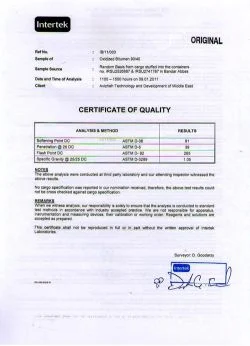
References and certificates