Best NPK Fertilizer for Houseplants (Complete & Practical Guide)
What Does NPK Mean in Fertilizers?
NPK refers to the three essential macronutrients required for healthy plant growth:
Nitrogen (N) supports leaf growth, green color, and photosynthesis.
Phosphorus (P) strengthens root systems and plays a critical role in flowering and energy transfer.
Potassium (K) improves overall plant health by regulating water balance, stress tolerance, and disease resistance.
The numbers shown on fertilizer labels (for example, 20‑20‑20) indicate the percentage of each nutrient by weight. Choosing the correct ratio is far more important than simply applying more fertilizer.
Why NPK 20‑20‑20 Is the Best General Choice for Houseplants
For most indoor plants, balanced nutrition produces the most consistent results.
NPK 20‑20‑20 is considered the best all‑purpose fertilizer for houseplants because it:
Encourages steady leaf growth without forcing it
Supports healthy root development
Maintains long‑term plant stability
This ratio is ideal for common leafy houseplants such as Monstera, Pothos, Ficus, Snake Plant, Aglaonema, and Dieffenbachia.
If you want one fertilizer that works for the majority of indoor plants, NPK 20‑20‑20 is the most reliable option.
When to Use High‑Nitrogen Fertilizer (NPK 30‑10‑10)
High‑nitrogen fertilizers are designed to accelerate vegetative growth.
NPK 30‑10‑10 is useful when:
Growth has slowed significantly
Leaves appear pale or undersized
Plants are recovering after repotting or propagation
However, excessive nitrogen can weaken root systems and reduce long‑term plant strength. For indoor plants, this formula should be used occasionally and always diluted.
Best NPK Ratio for Flowering Houseplants
When a healthy indoor plant fails to bloom, phosphorus deficiency is often the cause.
High‑phosphorus fertilizers such as NPK 10‑30‑20 or 15‑30‑15 support flower bud formation and energy storage.
Best suited for flowering houseplants including Anthurium, African Violet, Peace Lily, and Orchids.
These fertilizers should only be applied when plants receive sufficient light. Without adequate light, additional phosphorus will not improve flowering.
Liquid vs Powder vs Granular Fertilizers for Indoor Plants
Liquid fertilizers are the safest option for houseplants due to fast absorption and precise dosage control.
Water‑soluble powder fertilizers are cost‑effective and efficient but require accurate measuring.
Granular or slow‑release fertilizers are generally unsuitable for indoor pots because they can cause salt buildup and root damage.
For indoor environments, liquid NPK fertilizers provide the most predictable and controllable results.
Correct Fertilizer Dosage for Houseplants
A critical rule for indoor plant care is to apply half of the manufacturer’s recommended dosage.
Indoor soil systems are closed environments, meaning excess fertilizer salts accumulate quickly and damage roots.
Example: If the label recommends 2 ml per liter of water, use 1 ml per liter instead.
Under‑fertilizing is significantly safer than over‑fertilizing.
Seasonal Fertilizing Schedule for Indoor Plants
Spring and Summer: Apply diluted fertilizer every 2–3 weeks
Autumn: Reduce feeding to once per month
Winter: Stop fertilizing or apply very lightly every 6–8 weeks
Plant growth slows under low light and cool temperatures, making heavy feeding unnecessary during winter.
Most Common and Practical NPK Grades for Houseplants
Understanding widely used NPK grades helps prevent incorrect fertilizer selection.NPK 20‑20‑20 – All‑Purpose Indoor Fertilizer
The most commonly used fertilizer for houseplants worldwide.
Best for general maintenance, leafy plants, and long‑term feeding programs.
NPK 19‑19‑19 – Professional Balanced Grade
Similar to 20‑20‑20 but slightly milder.
Often preferred by nurseries and growers working with sensitive plants due to reduced burn risk.
NPK 30‑10‑10 – Vegetative Growth Formula
Promotes rapid leaf development.
Best used temporarily for weak plants or recovery periods. Overuse may cause unstable growth.
NPK 10‑30‑20 / 15‑30‑15 – Flowering Formulas
Designed to encourage blooming and bud formation.
Apply only during flowering stages and avoid continuous use.
NPK 12‑12‑12 / 14‑14‑14 – Low‑Risk Maintenance Grades
Gentle, balanced formulas suitable for beginners and low‑light conditions.
These grades minimize the risk of salt accumulation in pots.
NPK 15‑5‑30 – Stress and Resistance Formula
Higher potassium improves plant strength and tolerance to environmental stress.
Useful during hot seasons or for plants under light and water stress.
Common Signs of Incorrect NPK Use
Brown leaf tips indicate over‑fertilization
Fast growth with weak stems suggests excess nitrogen
Healthy leaves without flowers indicate phosphorus deficiency
Wilting despite watering may signal potassium imbalance
Recognizing these signs early prevents long‑term damage.
Final Recommendation: Best NPK Fertilizer for Most Houseplants
For a simple and safe solution, liquid NPK 20‑20‑20 remains the best choice for approximately 70% of houseplants.
Specialized formulas should be used only for specific purposes such as flowering or recovery. Balanced nutrition should always be the foundation of indoor plant care.
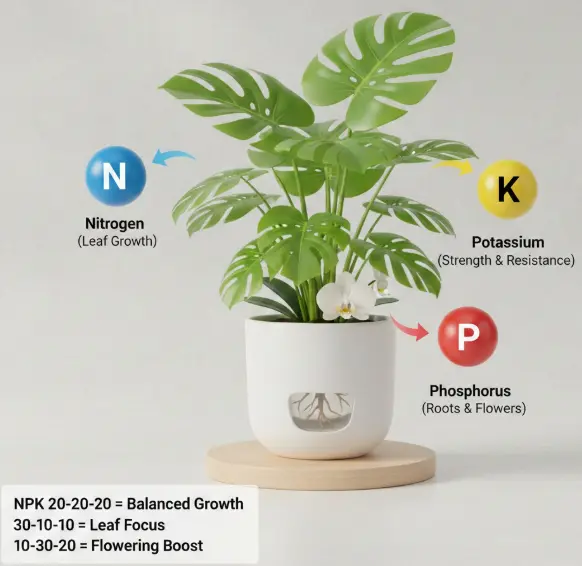
Table of Contents
References and certificates